
Federal Releases from Wagoner County
Place of arrest does not fix the place of federal confinement. The U.S. Marshals Service is responsible for federal prisoners from court-ordered custody through acquittal, court release, or delivery to BOP after conviction. USMS transports prisoners and contracts for detention space across many jurisdictions. A person can therefore leave a Wagoner-area jail for a federal court, contracted jail, transport hub, or BOP reception far outside the county.
BOP generally takes sentenced federal prisoners after commitment. Its Inmate Locator is the public historical tool for federal inmates from 1982 forward. It is not a complete pretrial USMS locator. Start with the federal docket and transfer record when BOP returns no match for a pretrial person.
| Custody stage | Primary source | Release meaning |
|---|---|---|
| Local jail with federal hold | WCSO release or transfer record | Shows local custody ended, not freedom |
| Federal pretrial custody | Federal docket, clerk, and USMS records | Court order controls detention or release |
| Sentenced federal custody | BOP Inmate Locator | Shows BOP location or historical release date |
| Federal supervised release | Judgment and U.S. Probation Office | Community status may continue after BOP custody |
No Federal Prison in Wagoner
No BOP institution was identified physically inside Wagoner County in the official sources reviewed. The facility entry represents a system that may receive a Wagoner person, not a local building. Do not invent a nearby prison or use the Wagoner County Jail address as a BOP location.
A federal defendant can still be held in local or contracted space while USMS controls the case. The actual jail may change without a final release. Use the federal case number, USMS transfer information, and BOP register number to follow the person across systems. County and federal records can both be correct because each records a different custodian.
Note: Wagoner County has no identified BOP prison, but local custody can end through a federal transfer to another jurisdiction.
Search Federal BOP Release Records
The BOP Inmate Locator accepts a BOP register number, DCDC number, FBI number, or INS number. A BOP register number uses the format #####-###. A name search uses first, middle, and last name, with optional race, age, and sex filters. The returned columns can include name, register number, age, race, sex, release date, and location.
- Use the register number when available. It offers the strongest match.
- If searching by name, include the full legal name and narrow with supported descriptors.
- Compare the result with the federal court case and judgment before accepting the identity.
- Read the location and release-date columns together. An institution indicates BOP custody, while a historical entry may show release wording.
- Save the access date. BOP warns that sentence calculations and release dates may be revised.
- Check other systems when the result says released or not in BOP custody, because another authority may still hold the person.
BOP Inmate Locator
Historical federal custody records from 1982 forward
The official BOP locator below displays the federal number and name routes used for a search.
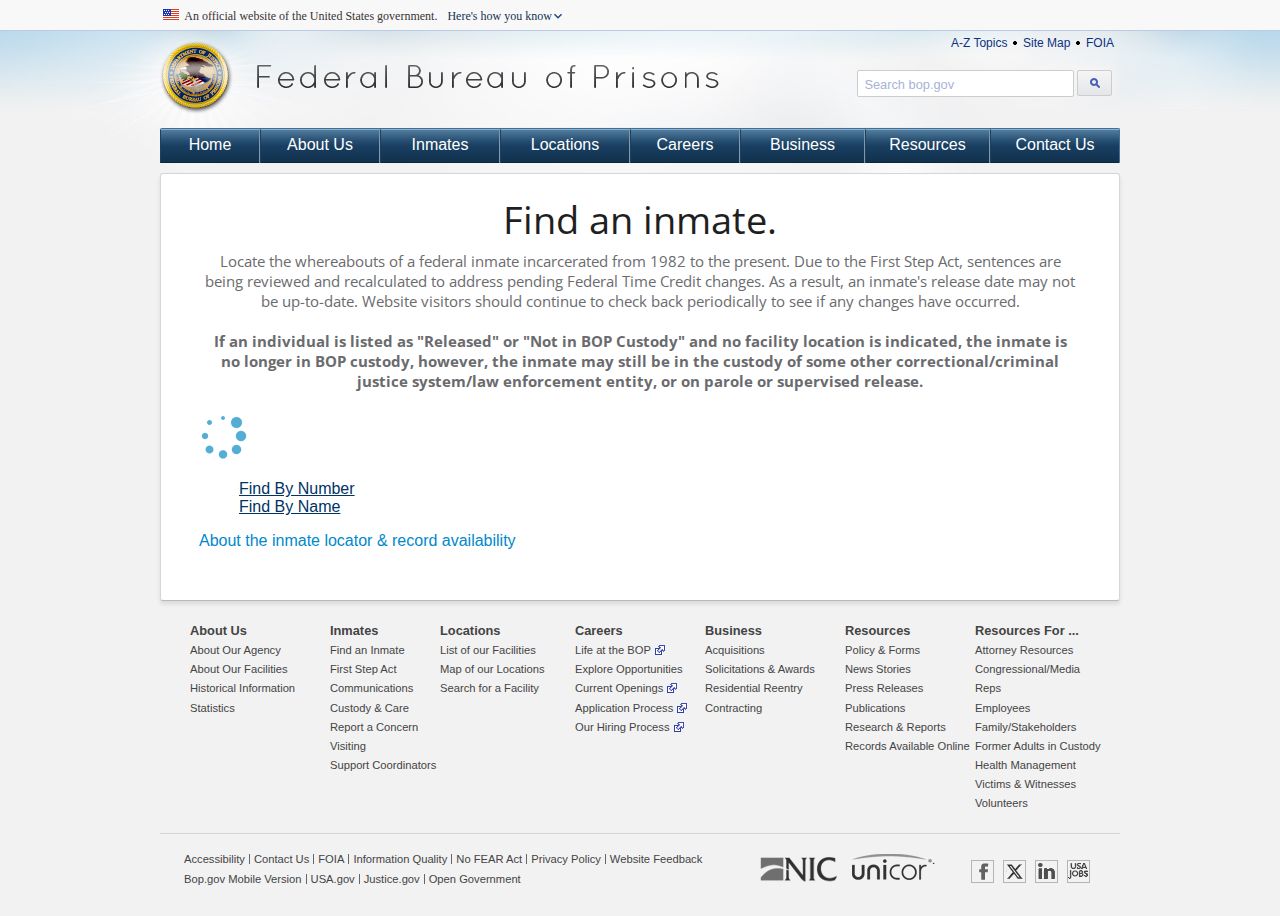
The screen identifies the correct public tool for a sentenced federal prisoner. It does not supply a complete USMS pretrial history.
Federal Released Status Explained
BOP states that “Released” or “Not in BOP Custody” with no institution means the person is no longer in BOP custody. That is useful and specific. It does not prove the person is free from all custody or legal control. State, local, immigration, or another federal authority may hold the person, and federal supervised release may continue in the community.
The First Step Act has led to sentence recalculations, so BOP warns that a displayed date can change. Treat a future date as a current projection. After it passes, check the refreshed locator, court docket, and any transfer information. A court order can also precede the practical completion of transport or release processing.
- USMS custody
- Federal pretrial and transport custody managed by the U.S. Marshals Service.
- BOP custody
- Federal prison custody generally following a sentence and commitment.
- Supervised release
- A court-ordered federal community term that may follow imprisonment.
- Federal detainer
- A federal request or basis affecting release from another custodian.
Wagoner Federal Pretrial Release
The U.S. Marshals Service custody explanation shows why BOP is not enough for a pretrial defendant. USMS holds responsibility from the court's custody order through acquittal, court-ordered release, or delivery to BOP after conviction. It may use non-BOP detention space and move a prisoner between a jail and courthouse.
No public person-level historical USMS locator comparable to BOP was identified. Use PACER or the relevant federal clerk to obtain the detention or release order. A locally generated record marked “USMS transfer” documents the handoff. It does not prove that the federal court later ordered community release.
USMS FOIA can be a records route, subject to privacy and law-enforcement exemptions, but it is not an instant location tool. Make a narrow request tied to the federal case, date range, and custody event. When the exact detention site is unclear, begin with the court docket and known transfer record instead of guessing where USMS placed the prisoner.
A BOP number may not exist yet for a person still in pretrial USMS custody. That is one reason a blank BOP search cannot prove release. Recheck the docket for a commitment, acquittal, release order, plea, sentence, or transfer. The docket date describes legal action, while the detention record supplies the physical movement.
Federal Court Release Proof
The federal docket explains the legal authority. A magistrate or district judge may enter detention, conditions of release, bond, judgment, commitment, sentence, revocation, or termination orders. Read entries around the custody date and obtain the filed order when the outcome matters. A docket entry is not a minute-by-minute door log, but it can show why USMS or BOP was required to act.
After a sentenced federal prison term, the judgment also shows whether supervised release follows. The U.S. Probation Office handles that court-ordered community term. A BOP locator result cannot by itself prove that supervision ended. Conversely, completion of supervised release does not rewrite the historical BOP release date.
Use a three-record model: the court order explains authority, the custodian's release or transfer record shows who ended physical custody, and the later system shows the destination or supervision status. That model prevents a local transfer from being mislabeled as final federal release.
Wagoner Jail to Federal Custody
When WCSO records a person as released to USMS or on a federal hold, local physical custody ended. Search the current roster only as a conflict check. The county's rolling release card may provide booked and released timestamps but does not promise a destination field. For a complete event, ask WCSO for the booking record, release code, transfer agency, and destination if public.
The Wagoner County Jail is at 307 E. Cherokee St., Wagoner, OK 74467. The jail line is 918-485-7730, while the office line at 918-485-3124 is described as answered 24 hours. For an older transfer, WCSO Records accepts in-person requests on weekdays from 9 a.m. to 3 p.m. Use the federal case number and approximate date to narrow the search.
A VINE update can corroborate county movement but does not replace the federal docket or original transfer entry. If the person later appears in BOP, that state of the record confirms the sentenced federal custody path rather than immediate community release.
Ask whether WCSO recorded USMS, BOP, another jail, or a federal writ as the destination. A field may be limited by an exemption, but naming it gives the records office a clear task and avoids asking it for a legal conclusion.
Confirm a Federal Release Destination
Match the evidence to the last known system. For BOP, use the locator and judgment. For a pretrial USMS defendant, use the federal docket, clerk, and USMS records route. When BOP says released, check whether the judgment imposed supervised release and whether another locator shows new custody. When WCSO says released to a federal agency, follow the named agency.
The Wagoner County release-record search covers the local booking and records-request steps. It can establish the time county custody ended before the federal chain began. Keep that local event separate from a later BOP release date.