
Wagoner County VINELink Release Coverage
OK VINE through VINELink is a free and confidential custody-search and notification service available continuously. Oklahoma sources describe participation by county jails and ODOC across all 77 counties. Wagoner County's connection is especially direct because the Sheriff's inmate-search page displays the OK VINE number and sends users to the service when a person may have been released or transferred.
The coverage crosses two systems without making them identical. A Wagoner County Jail update concerns local custody. An ODOC record concerns state incarceration or supervision. VINELink can carry information from both participating sources, but the reporting agency shown on the matched record matters. It does not turn a county exit into a state discharge, nor does it prove the legal outcome of the criminal case.
The telephone path matters when web access is limited or when a registrant prefers voice alerts. Oklahoma lists 1-877-654-8463 for OK VINE, and WCSO repeats that number in its own inmate-search material. Telephone access still depends on a correct person match and the agency feed. Keep the record identifier at hand, listen for the reported agency, and use the PIN process to acknowledge a notification rather than relying on caller identification alone.
Custody notification
An alert based on a participating agency's status feed. It reports a change but does not replace the original jail, corrections, or court record.
Search a Wagoner County Inmate
Search one person at a time and begin with the best identifier available. A full name can produce several candidates, especially when spellings or aliases vary. Compare the reporting agency, status, descriptors, and any identifier before opening or registering on a record. Do not merge two people merely because they share a name.
- Open VINELink. Choose Oklahoma as the state or territory.
- Select offender search. Enter the person's name or identifying number accepted by the live form.
- Narrow the candidates. Use available descriptors and known agency facts rather than choosing the first result.
- Open the matched profile. Check that the identity and reporting agency fit the known custody event.
- Read status and location together. Record the exact displayed wording and status date instead of paraphrasing too broadly.
- Confirm a county exit. Compare the result with WCSO's release feed or request the original record if the public window has passed.
For a full search across county jail, court, ODOC, federal, and immigration channels, follow the Wagoner County released-inmate lookup. VINELink is deliberately narrower: it checks a particular person and supports later alerts.
The manifest capture comes from the Oklahoma VINELink search start used for state selection and the beginning of a one-person query.
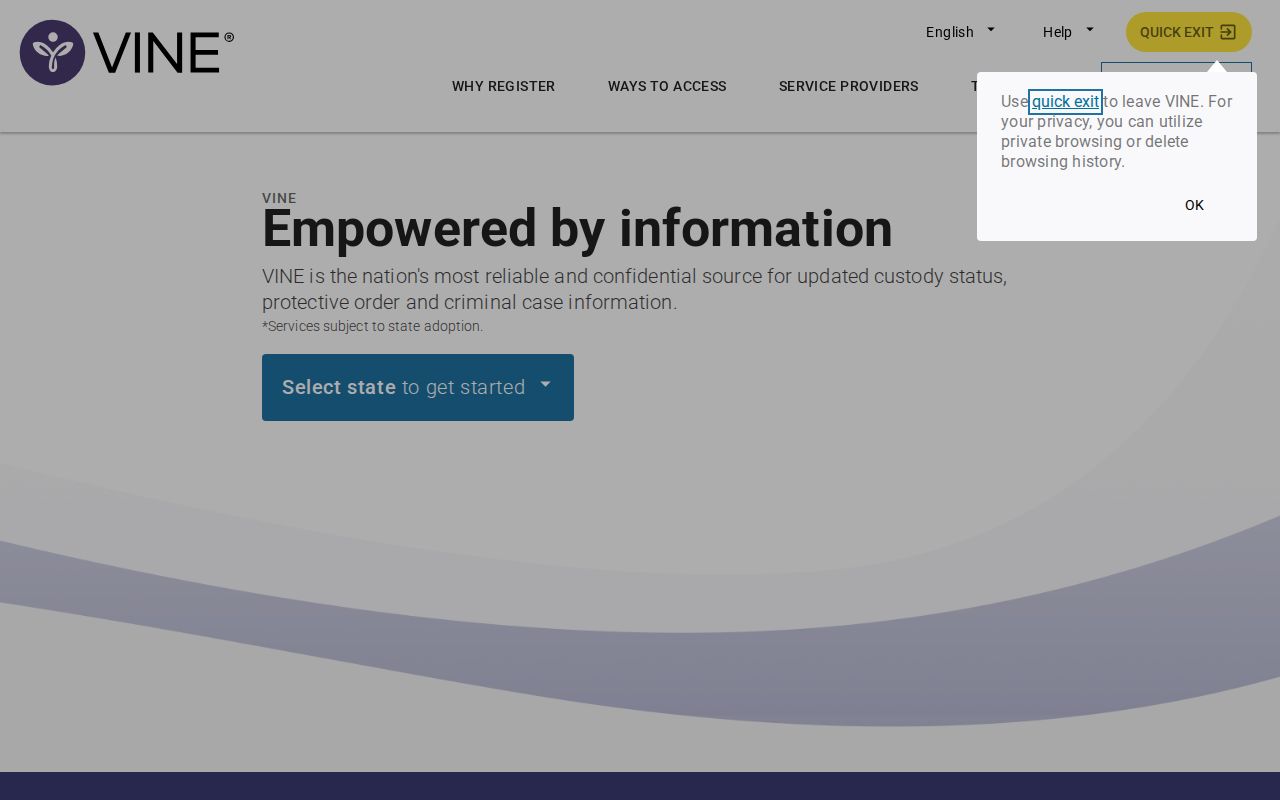
This image documents the access path only. No personal result should be inferred from a generic search-start screen.
Wagoner County VINELink Result Fields
The live matched profile controls which details are available. Oklahoma guidance supports reading the reporting agency, custody status, public location, identifying information, and status date as displayed. Fields can differ by custodian and record. A county-jail result should not be forced into the same interpretation as a state-prison record.
| Field | How to read it |
|---|---|
| Name or offender identity | Starting point for the match; compare other details before deciding it is the correct person. |
| Reporting agency | Identifies the participating jail or corrections source feeding the custody status. |
| Custody status | Shows the service's current reported wording, such as in custody, released, or out of custody when supplied. |
| Location | Shows a facility or agency location when the custodian makes it public. |
| Status date | Places the reported change in time; it may not equal a court filing or final sentence discharge. |
| Identifier or descriptors | Helps separate same-name people and tie the result to the right agency record. |
| Notification options | Offers available registration methods from the matched profile. |
A VINE status of released or out of custody is useful corroboration, but it remains an agency-feed indication. For a Wagoner County jail exit, the Sheriff's release timestamp or custody log is stronger proof of the local event. For an ODOC discharge, use the ODOC record. For a case outcome, read the court docket or certified filing.
Note: Record the reporting agency and status date because the same person can move between county, state, and other custodial systems.
Register Wagoner County Release Alerts
Registration begins from the correctly matched person record, not from a broad list of search results. The live interface may offer telephone, text, email, in-app, or TTY delivery. Availability can vary. Choose a destination the registrant controls and complete the verification steps shown on screen. Registration is confidential, but a shared telephone or inbox can expose the alert to others who use it.
- Open the correct record. Recheck the name, agency, and identifier before registering.
- Choose registration or notification. Select one or more methods offered by the current interface.
- Enter the destination. Supply the requested phone number, email address, or app setting.
- Complete verification. Follow the code, confirmation, or other live prompt for the chosen method.
- Create the phone PIN. When telephone alerts request one, set the PIN during registration.
- Acknowledge the call. Enter the PIN on the automated call so the system knows the alert was received and can stop repeat calls.
Keep the registration tied to the same matched person. If a later alert mentions transfer, release, return, escape, death, or another change, read the exact message before drawing a conclusion. The type of notice determines what happened in the feed. A release notice by itself does not show that a sentence ended or that no other agency assumed custody.
Review contact details after registration. A changed phone number, blocked automated call, full mailbox, spam filter, or disabled app permission can prevent the notice from being received even when the custody feed updates. VINELink is a notification aid, not a promise that every delivery route will work without interruption. Keep the correct person record available and consult the service's current registration screen when changing a destination.
Wagoner County VINE Handoff
Wagoner County's own inmate-search page creates a useful local handoff. It labels the main list as current custody and points to OK VINE when a person may have been released or transferred. The page also publishes the Oklahoma VINE telephone route, 1-877-654-8463. This is stronger local support than a generic claim that VINELink might cover the jail.
That handoff also explains why the two systems should be read in sequence. First, determine whether WCSO still lists the person. Second, search the official 72-hour release page for a recorded local exit. Third, use VINE to see whether a participating agency now reports release, transfer, or another status. If an ODOC record appears, inspect the state status rather than calling the county exit a community release.
Parole-consideration notice is outside this VINE function. The Oklahoma Pardon and Parole Board has its own victim-notification process, meeting materials, and results. VINE reports custody events from participating agencies; it does not notify users that the Board will consider parole. Keeping those services separate prevents an alert from being mistaken for a Board decision.
Confirm a Wagoner County Release
Corroboration should match the system named by the alert. For WCSO, compare the VINE result with the Sheriff's 72-hour release card and its Booked and Released timestamps. When that web window has expired, request the booking, custody, and release summary from WCSO Records. Ask for a release code or transfer destination if those fields exist and are public.
For ODOC, search the official offender lookup with the DOC number when known. Read incarceration, parole, probation, discharge, facility, and sentence information according to the exact labels shown. A projected or tentative date is not proof that release occurred. If the case points to a municipal custodian, another county, or a federal or immigration authority, contact that record holder rather than assuming the Wagoner County feed should contain the event.
VINE can support
A participating agency's reported status, status date, location when public, and future custody-change notification.
VINE cannot replace
The original release log, transfer record, court disposition, ODOC discharge document, or final sentence computation.
Wagoner County VINELink Limits
No match is not proof of release. Spelling, aliases, feed timing, protected records, age restrictions, or the wrong custodian can produce an empty search. Transfers can interrupt or change which participating agency supplies the record. Oklahoma guidance also warns of a visibility interruption during certain movements from ODOC to a state mental-health facility until the person returns.
VINELink is not the BOP Inmate Locator. A sentenced federal prisoner should be checked in BOP's historical locator, while a federal pretrial defendant may remain in a U.S. Marshals Service custody chain that lacks a comparable public historical person search. ICE has a separate locator for current detention and a limited recent-release period. A VINELink no-result says nothing conclusive about those federal systems.
When facts conflict, preserve the exact VINE wording, agency name, status date, and check time. Then contact the reporting jail or corrections department. The government record created by that office resolves the custody event more reliably than a remembered alert or an unmatched name search.
For an older WCSO event, give Records the full name, birth date if known, approximate booking period, and booking or case number. Request the custody log or release summary, actual exit date and time, release code, and transfer destination if recorded and public. If the VINE result concerns ODOC instead, use the DOC number and state records route. These focused requests preserve the distinction between the notification and the government source data behind it.
Municipal custody can fall outside the expected county path. A City of Wagoner Jail record, Coweta municipal case, or Broken Arrow municipal-jail event may require the city corrections desk and municipal court even though the person or arrest is tied to Wagoner County. VINELink participation should not be assumed for a particular municipal record without a matching result. Ask which agency physically held the person, then search or request from that custodian.