
Wagoner County Projected Release Meaning
Oklahoma uses several dates that must remain distinct. ODOC's official worksheet is titled “PROJECTED RELEASE DATE.” Board result tables may abbreviate that field as PRD and list a PE Date beside it. The parole eligibility date marks when consideration may occur. A projected release date is an estimate built through sentence administration. An actual release date records a completed custody event. A parole date can start supervised community status before full discharge, while a discharge date can mark the later end of the administered sentence.
Pretrial custody works differently. A person held in Wagoner County Jail before judgment does not have an earned-credit release schedule like a sentenced ODOC prisoner. Bond, a court order, dismissal, a plea, a hold, or transfer can govern the next move. Even a court order may precede the time when jail staff finish identity checks, warrants, property, and transfer processing.
- PRD
- A projected release date used in Oklahoma sentence administration.
- PE Date
- A parole eligibility date, which is not a promised release day.
- Detainer
- A request or legal basis for another authority to take or keep custody.
- Discharge
- The end point reflected by the controlling corrections record, distinct from a parole release.
Find a Wagoner County Projected Release
Start by deciding whether the sentence belongs to Wagoner County jail administration, ODOC, federal custody, or another system. The current WCSO roster cannot answer a future state-prison date, and the ODOC search is not a history of every local booking. Use a DOC number, booking number, and court case number whenever possible.
- Read the filed judgment and commitment. Identify the sentence term, beginning or reception date, jail-credit award, consecutive or concurrent terms, and the agency charged with administration.
- For an ODOC case, search ODOC Offender Lookup by DOC number or carefully matched name. Record the exact status and date labels shown.
- Do not assume the public record will reveal a precise future day. ODOC says exact inmate release dates are confidential absent a legitimate need.
- For a Wagoner County jail sentence, ask WCSO for the booking timestamp, court commitment, jail credit, holds, and release record. Ask which agency computed the term if an ODOC commitment was involved.
- Compare the parole eligibility field with the Board result when parole is relevant. A Board action is not the same as release processing.
- After the estimate passes, verify an executed release through the custody record, agency status, VINE, or the receiving system.
The official ODOC search interface shows the identifiers available to begin a state record match.
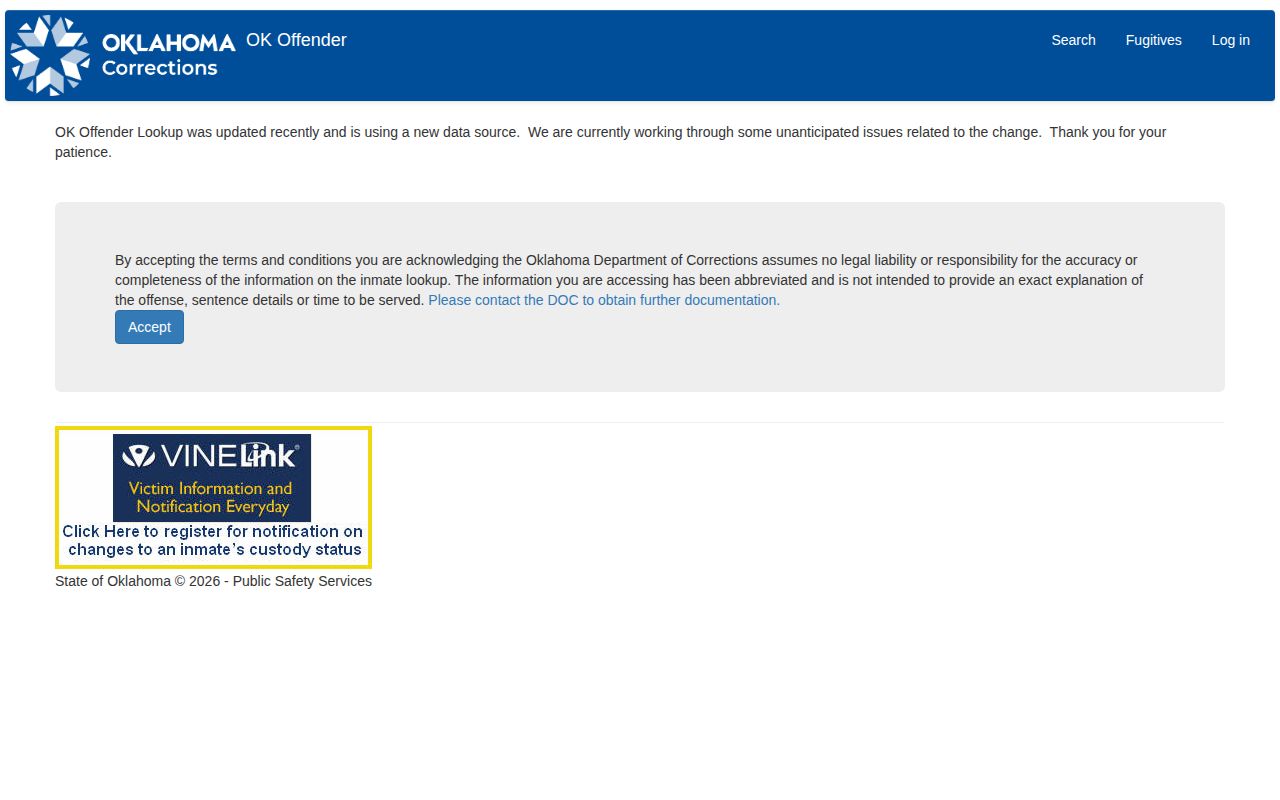
The screen is a starting point for identity and current status. It should not be presented as a guarantee that every record contains a public exact PRD.
Wagoner County Release Date Confidentiality
Oklahoma's public guidance sets a crucial limit. The ODOC Offender Information page says an inmate's release date is confidential unless the requester has a legitimate need, such as a qualifying judicial or law-enforcement purpose. It also says inmates receive their days remaining each month and can calculate the date or ask a facility records officer or case manager. Public copy must not promise that an exact day appears for every person in Offender Lookup.
The same guidance explains that the date is tentative. Earned-credit level, misconduct, and achievement credits can change the balance. That controlling warning is visible in the official ODOC source below.
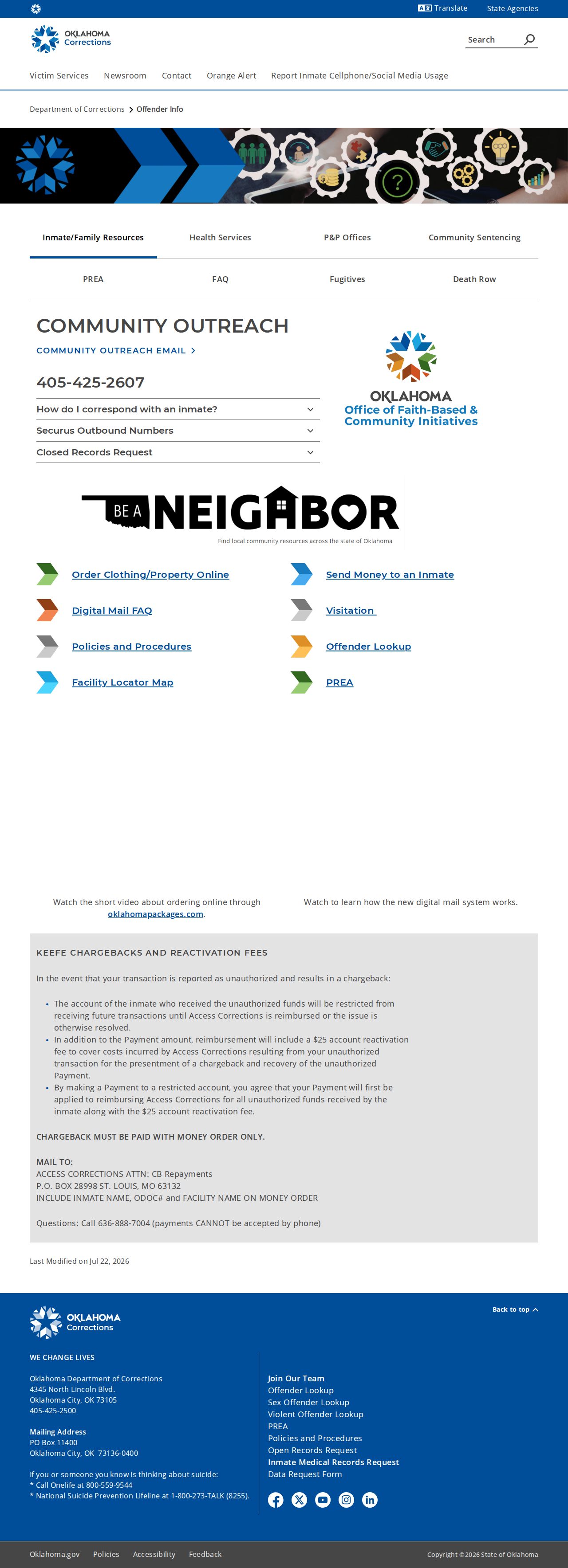
The image supports directing the inmate to the monthly days-remaining statement or facility records staff. It does not authorize public disclosure of protected information.
An open-records request is not a way around that restriction. ODOC may release public status history, an actual discharge field, or other segregable material while withholding a confidential future date. General Counsel is listed at 405-425-2515, Closed Records at 405-425-2691, and discharge inquiries at osordischarges@doc.ok.gov.
Wagoner County Sentence Credit Calculation
ODOC's “Service of Sentences and Credit Applicable” explanation starts with the sentence term and the reception or beginning date. The system converts that term into days remaining, then adjusts the balance for days served and credits earned or lost. Discharge occurs when days remaining reaches zero. Pre-sentence jail credit generally depends on the sentencing order. Post-sentence county-jail time and delayed reception are addressed by 57 O.S. §138.
Credit class can materially alter the projection. The current statutory schedule includes Level 1 at zero credits per month, Level 2 at 22, Level 3 at 33, Level 4 at 44, enhanced Level 3 at 45, and enhanced Level 4 at 60. One credit is one day. Eligibility, conduct, work or program assignment, statutory exclusions, and ODOC administration control the award. Achievement and meritorious-act credits are separate factors.
Misconduct can remove credits through the required procedure. Credits may later be restored. Court modifications, corrected jail credit, additional cases, sentence audits, and revised records can also change the computation. ODOC publishes rough multipliers and a quickest-time illustration, but expressly leaves out many variables. Those examples teach the framework. They are not a personal calculator and should never be used to announce a release day.
Note: The inmate's monthly days-remaining information and facility records staff are the official case-specific calculation channels identified by ODOC.
Wagoner County 85 Percent Rule
21 O.S. §13.1 requires people convicted of enumerated offenses within its effective scope to serve no less than 85 percent of the imprisonment term before parole consideration. Earned credits cannot reduce confinement below that floor. The statute's offense list and versions have changed, so the offense date and operative law must be identified before applying it.
The rule does not mean every Oklahoma sentence equals 85 percent in custody. It also does not mean a covered person leaves on the day the threshold is reached. Parole can be denied. Detainers, consecutive sentences, additional cases, sentence audits, and restricted credits may keep custody in place. Life without parole and death sentences are not parole eligible.
Title 57's restricted-credit rules are not identical to Title 21's enumerated 85 percent list. Merging them creates a false estimate. Use the judgment, offense date, statute, ODOC calculation, and later status rather than applying one percentage to the face value of a sentence.
Why Wagoner County Release Dates Change
A projected date is a working result. Some changes come from the person's credit class and conduct. Others come from courts or a second custody system. The date shown on a Board result or prior printout may therefore differ from the current agency calculation.
| Factor | Effect on the projection | Record to check |
|---|---|---|
| Earned or achievement credits | May reduce days remaining within statutory rules | ODOC monthly balance and sentence record |
| Misconduct or restoration | May remove or later restore credits | ODOC sentence administration |
| Jail-credit correction | Changes credited time already served | Court order and ODOC audit |
| Added or corrected case | Can change the controlling term | Court judgment and ODOC sentence record |
| Detainer or hold | May prevent community release or cause transfer | Release record and receiving agency |
| Parole action | May move the person to supervised status before discharge | Board result and ODOC status |
A favorable Board result can still be followed by conditions, required Governor action, release planning, misconduct review, or a sentence audit. “Parole to detainer” is not freedom in the community. Read the outcome words and then check the custody record.
The Board's public result can include both PE Date and PRD in the same row. That side-by-side display is useful only when the labels stay intact. Eligibility is the point at which a case may be considered, while PRD remains a sentence calculation. Monthly dockets can show a pass, defer, denial, recommendation, grant, or detainer result. None is a substitute for later ODOC custody status. For a Wagoner County case, match the DOC number, county, case number, offense, sentence term, action date, and result before using the row. A same-name entry or earlier docket may concern another person or stage.
Wagoner County Jail Release Calculations
A local jail sentence requires local documents. Obtain the judgment or commitment, the jail-credit award, booking timestamp, any holds, and the final WCSO release record. If the person was waiting for ODOC reception or serving time tied to a state judgment, ask which agency maintained the controlling computation. The Court Clerk supplies the filed order, WCSO supplies the physical custody timestamps, and ODOC supplies state sentence administration.
No official local source reviewed documented a Wagoner County-specific good-time policy, a guaranteed exit hour, or a weekend and holiday release rule. Do not fill those gaps with a practice from another county. Call the Wagoner County Jail at 918-485-7730 for case-specific processing. Its office line, 918-485-3124, is described as answered 24 hours.
A court order for time served can authorize release while another hold prevents departure. A WCSO entry marked released may also reflect transfer to ODOC, another jail, federal authorities, or ICE. Ask for the release code or destination when the public 72-hour card does not answer that part.
For an older county event, send a narrow request to WCSO Records. Identify the full name, date of birth if known, booking number, approximate dates, and court case. Ask for the existing booking sheet, custody log, release date and time, recorded release reason, and transfer destination if public. This evidence can show whether the estimate became an actual local release, while the judgment explains the authority. The public web card expires from view after its rolling window, but the research found no promise that the source record is destroyed then.
Confirm Wagoner County Actual Release
After a projected day arrives, search for a completed event. For Wagoner County Jail, use the Sheriff's 72-hour release view or request the historical release entry after the card expires. For ODOC, read the updated status, actual parole or discharge information, and any releasable record. For a transfer, follow the receiving agency. The current roster is only a conflict check because disappearance alone does not prove release.
OK VINE can provide custody-status changes for participating county jail and ODOC records. The Wagoner County VINELink inmate search explains how to match one record and register for alerts. A notification may indicate release or transfer, but it is not a sentence-discharge certificate or a court disposition.
Save the exact label, date, agency, and access time. Then resolve conflicts with the record holder. A tentative PRD, Board vote, VINE alert, and jail release timestamp are related evidence, not interchangeable facts.